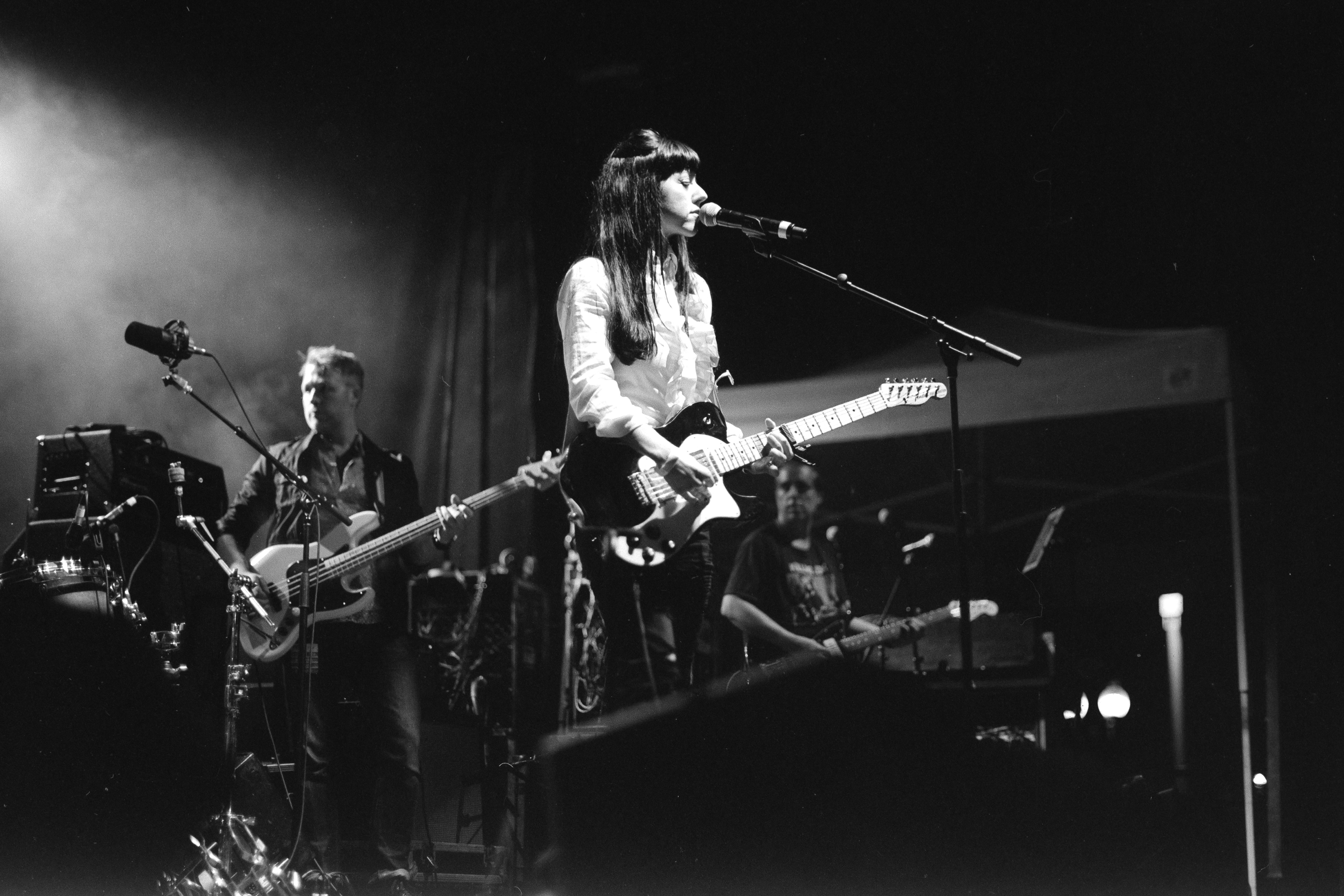
Fifty Years Old, and Still Faster Than Anything Else
Medium format isn't supposed to do this. It's supposed to be slow, deliberate, stop-down, tripod-adjacent. You don't take medium format to a dim concert and shoot wide open at a singer mid-scream. You take it to a controlled studio or a landscape with three hours of light to work with.
The Mamiya 80mm f/1.9 ignored every part of that. Mamiya introduced it in the mid-1970s for the 645 system and kept making it for more than fifteen years — a sign that, despite never being a casual purchase, it found its audience. At around $275–$300 new (roughly $1,000 in today's money), it was substantially cheaper than the Hasselblad competition, which is part of why it's still talked about in vintage gear circles half a century later.
The headline number, and what it actually means
The f/1.9 aperture sounds modest until you remember the format. On medium format 645, f/1.9 produces depth-of-field behavior closer to f/1.1 or f/1.2 on 35mm — but with smoother focus falloff than any fast 35mm lens I've used. The big negative means the lens doesn't have to work as hard. The transitions look natural. Subjects lift off the background in a way that feels three-dimensional in the literal sense.
The lens exists for exactly one reason: to let medium format shooters go places medium format doesn't normally allow them to go. Bad light, fast motion, shallow depth of field as a creative tool rather than a structural one.
Build
You expect the fastest medium format lens in the world to be enormous. It isn't. It's compact, dense, and balances nicely on a 645 body. It's lighter than my Canon 50mm f/0.95 Dream Lens and lighter than the Canon EF 50mm f/1.0. All metal and glass. Engraved, enamel-filled markings. Long, usable focus throw — which you need, because depth of field at f/1.9 on 645 is wafer thin. Six-blade aperture. Minimum focus 0.7 meters. 67mm filter threads.
Nothing about it is flimsy. It was built with the assumption that it would keep working long after we were done with it. And so far, it has.
In the field
Focusing this lens isn't as hard as you'd expect. Counterintuitively, it's actually easier to focus than the 80mm f/2.8 on the same body — because the brighter image hitting the focusing screen makes every focusing aid in the camera work better. After some time with it, my hit rate is as good as, or better than, modern fast lenses on autofocus digital bodies. You'll miss focus regularly when you're shooting at f/1.9. That's table stakes.
I bought this lens originally for a specific reason: medium format concert photography. Conventional wisdom says nothing about that idea makes sense. Concert venues are dark. Subjects move constantly. Medium format cameras are big, slow, and deliberate — none of which fits with holding a beer in one hand and a camera in the other up by the stage.
But the combination of f/1.9 and a 645 negative produces something other lenses simply can't. You can shoot wide open to keep shutter speeds high, freeze motion, and avoid push-processing your film to death. Focus tracking is out — you don't track on a lens like this. You anticipate. You wait for the singer to step to the microphone. You wait for the guitarist to step into the light. When the picture lands, it's the kind of frame that makes people ask how you did it.
A bonus, if you're into it: with a light source in the frame, this lens produces gorgeous rainbow flares. Perfect for concert work. Perfect for cinematic mood.
Image quality
This lens does not fall apart wide open. You might fall apart wide open, but this lens does not.
Center sharpness at f/1.9 is genuinely very good. Contrast is solid. Detail holds up. But sharpness isn't really why you own this lens — the subject-to-background separation is. Straight lines stay straight. There's no smearing at the edges of the image circle. The character is consistent across the frame. And the rendering has that natural, unforced quality medium format gives you when the lens isn't being asked to do too much.
Adapting to modern cameras
It works on Fuji GFX. The image circle covers the sensor cleanly, and you get most of the wide-open character. The catch is that medium format digital sensors are still smaller than 645 film, so you never get the full image circle without a focal reducer.
You can also adapt it to full-frame mirrorless or DSLR. I used it on a Canon 5D Mark II years ago and it held up better than I expected. But I wouldn't buy this lens for that purpose. There are dozens of fast 80mm lenses designed for full frame digital that will do that job with more features and better autofocus.
The verdict
If you shoot medium format film, this lens is easy to recommend. It's unique, it performs beautifully wide open, and the look is genuinely hard to replicate.
If you're adapting to medium format digital like GFX, it still makes a strong case for itself — especially compared to the cost of native lenses for those systems.
If you're thinking about it just for full-frame digital, give it a pass.
You own this lens because of its character wide open. If you don't shoot wide open, the magic mostly doesn't show up. And if you do shoot wide open, you have to slow down enough to work with it deliberately — anticipating moments, waiting for light, missing focus occasionally and moving on.
In a world where modern cameras are designed to make every shot easier, there's something genuinely valuable about a fifty-year-old piece of glass that asks for your attention, rewards it disproportionately, and gives you images nothing else can.